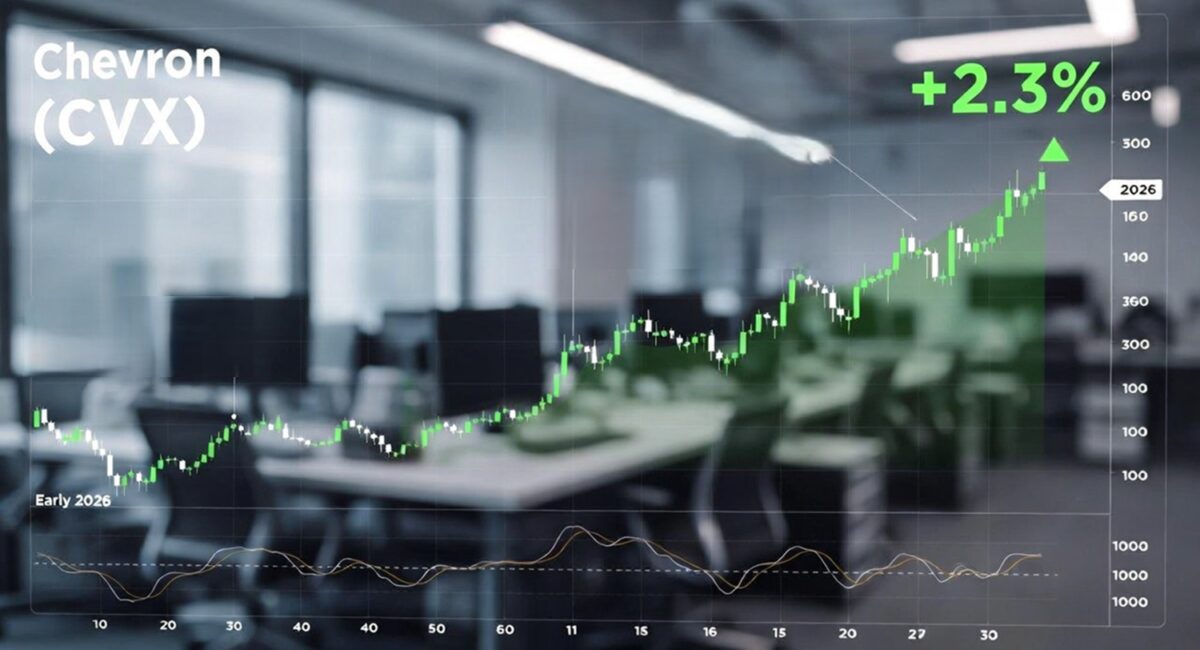
Chevron stock (CVX) opened 2026 on a surprisingly strong note, climbing about 2.3% on the first trading day of the year, a move investors directly tied to a combination of OPEC+ supply expectations, geopolitical developments including Venezuela, and broader energy market momentum. Chevron closed at roughly $155.90 per share, outperforming part of the broader market as oil majors rallied alongside crude’s tentative stabilization following a steep downtrend in 2025.
The jump in Chevron stock reflects a growing perception among traders that energy markets might be entering a more favorable phase—where supply discipline by producers like OPEC+ could support pricing and provide better profit visibility for integrated oil companies. With an OPEC+ meeting scheduled at the start of the year, expectations that current production targets might be maintained helped buoy sentiment around CVX, even as crude futures remained in a relatively narrow range.
Beyond OPEC+, geopolitical headlines involving Venezuela have also entered the Chevron narrative. The U.S. military operation in Venezuela and the reported capture of President Nicolás Maduro has injected uncertainty into global oil supply discussions, particularly given that Venezuela holds some of the world’s largest oil reserves. Even though Venezuela’s production remains far below historical peaks due to sanctions and infrastructure issues, Chevron is uniquely positioned among U.S. supermajors because it continues exporting Venezuelan crude under a special U.S. license—a dynamic investors are watching closely as policy developments unfold.
Despite the early January gains, Chevron faces headwinds headed into the upcoming Q4 2025 earnings report. Analysts expect a material dip in earnings for 2025 compared to the prior year—with forecasts suggesting adjusted earnings per share could fall nearly 25–27% year-over-year—highlighting the cyclicality and short-term pressures inherent to the oil sector. This anticipated earnings weakness adds nuance to Chevron stock’s rally, reminding investors that headline geopolitics and commodity momentum don’t fully insulate operational performance from macro and sector headwinds.
While Chevron benefits from its diversified global footprint and strong balance sheet, another layer of stock market chatter centers on company fundamentals and investor positioning. For example, insider activity indicates recent selling with no corresponding purchases—something market watchers interpret as a signal of cautious confidence rather than outright bullish conviction. Top-tier dividend yields and cash flow projections fueling future growth, including a projected $12.5 billion free cash flow forecast for 2026, underpin long-term investor interest even as short-term volatility persists.
Importantly, the Venezuela factor isn’t a simple positive for Chevron stock, at least not immediately. While reopening or expanding oil operations in Venezuela could eventually provide meaningful upstream upside—especially given the heavy crude’s attractiveness to U.S. Gulf Coast refiners—that potential is contingent on political stability, regulatory clarity, and the status of U.S. sanctions, all of which remain fluid in early 2026. At present, Venezuela contributes a relatively modest portion of Chevron’s total production, making broader market and OPEC+ dynamics more significant drivers of near-term stock performance.
Investors eyeing Chevron stock should also weigh upcoming catalysts beyond geopolitical headlines. The late-January earnings report will likely set the tone for 2026 expectations, clarifying how operating costs, refining margins, and global demand forecasts are shaping up after a challenging oil price environment. At the same time, energy markets are watching how OPEC+ decisions unfold, with production strategies from Saudi Arabia, Russia, and allied producers set to influence supply balances through the first quarter.
In summary, Chevron stock’s early 2026 rally — exemplified by its 2.3% gain at the start of the year — has been driven by optimism around OPEC+ stability, geopolitical developments like the Venezuelan situation, and fundamental cash flow prospects. Yet beneath this positive start, investors must balance expectations against earnings headwinds, regulatory uncertainties, and the broader commodity backdrop that continues to challenge energy equities. With multiple catalysts on the horizon—from earnings to global supply decisions—the coming weeks will be pivotal in shaping Chevron’s trajectory and whether the current momentum can be sustained into the heart of 2026.