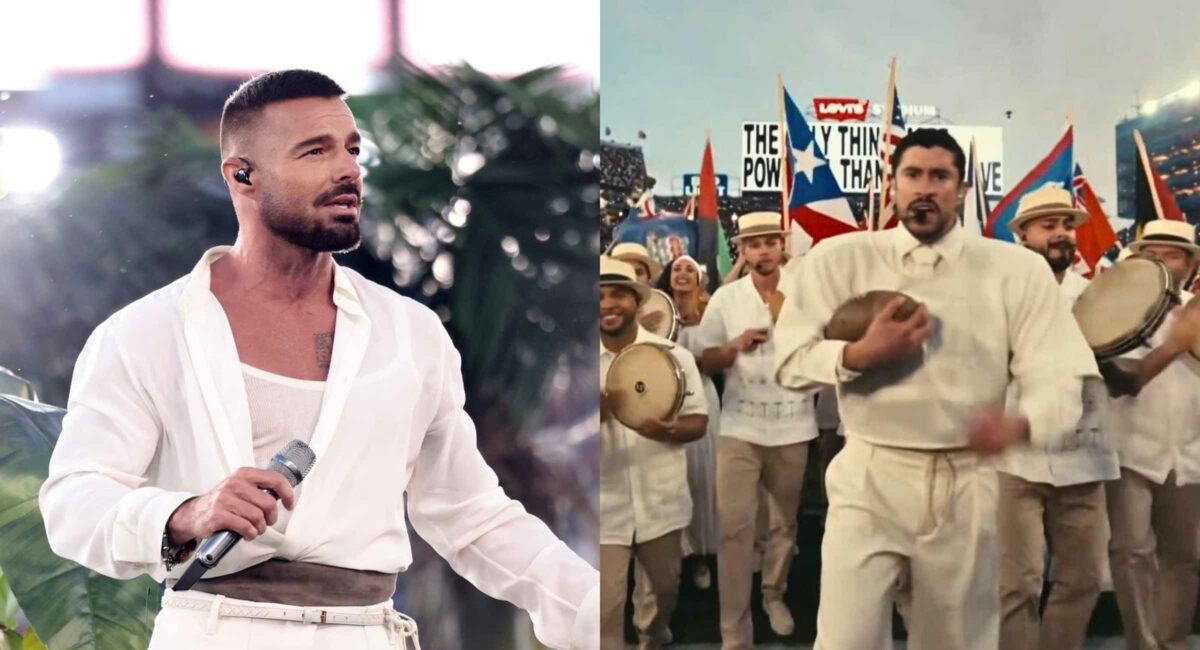
In one of the most talked-about halftime shows in NFL history, Bad Bunny’s Super Bowl 2026 performance didn’t just entertain — it broke viewing records, elevated Latin culture on the world’s biggest stage and closed with a unifying message displayed on a football that read “Together We Are America.” According to early data circulating on social media and industry trackers, the show reached an estimated ~142 million viewers, a potential new halftime record, and featured high-profile guest appearances from Lady Gaga and Ricky Martin that amplified its cultural resonance.
Post-Show Takeaways
- Viewership: Projected ~142 million viewers — potential new halftime record.
- Performers: Bad Bunny, Lady Gaga, Ricky Martin.
- Unique Achievement: First all-Spanish led Super Bowl halftime show.
- Core Message: “Together We Are America” — unity and inclusivity.
Here’s my authoritative, fact-checked review of this historic moment — from the music and symbolism to the reaction and potential legacy.
Bad Bunny’s Super Bowl 2026 Halftime: The Instant Overview
- Headliner: Bad Bunny (Benito Antonio Martínez Ocasio) — first solo artist to perform almost entirely in Spanish at the Super Bowl halftime show.
- Date & Venue: February 8, 2026 — Levi’s Stadium, Santa Clara, California, during Super Bowl LX.
- Guest Artists: Lady Gaga, Ricky Martin, and appearances from Pedro Pascal, Jessica Alba, Cardi B, Karol G, among others.
- Estimated Viewership: ~142 million viewers worldwide — potentially a new halftime record.
- Core Message: “Together We Are America,” shown on a football Bad Bunny held up at the end of the performance, emphasizing unity and inclusivity.
Setting the Stage: A Cultural Celebration, Not Just a Show
Bad Bunny stepped onto the Super Bowl stage shortly after winning Album of the Year at the 2026 Grammys for DeBÍ TiRAR MáS FOToS, a milestone that gave his performance both pop-culture momentum and emotional weight.
Dressed in an all-white, fashion-forward outfit featuring the jersey name “Ocasio” and number 64 — widely interpreted as a tribute to his family roots — he opened his set with “Tití Me Preguntó,” kicking off a vibrant celebration of Puerto Rican heritage and Latin music traditions.
Sources confirm this was the first time a Latino artist headlined a Super Bowl halftime show with an almost entirely Spanish setlist, a significant cultural milestone for both the NFL and global pop music.
The Performance: Hits, High Energy & Symbolism
Music & Flow
Bad Bunny curated a high-impact set that featured a blend of his greatest hits — from reggaetón anthems like “Yo Perreo Sola” to deeper cuts such as “El Apagón.”
What’s noteworthy is how the performance interwove music with narrative production elements: a sugar cane field backdrop, La Casita — a nod to his Puerto Rican roots — and a staged wedding that brought the crowd into the emotional core of the show.
Guest Appearances: Elevating the Moment
- Lady Gaga delivered a surprise salsa-inflected rendition of “Die With a Smile,” blending her pop sensibilities with classic Latin rhythms.
- Ricky Martin appeared later in the set, reinforcing the performance’s celebration of Latin culture.
These collaborations weren’t just star cameos — they served as symbolic bridges between powerful pop icons and Latin music’s ascending global presence.
Message & Visuals
Bad Bunny’s performance culminated with him holding up a football emblazoned with “Together We Are America,” a phrase that resonated across social media and was amplified by screens showing, “The only thing more powerful than hate is love.”
This wasn’t just a creative flourish — it was a clear call for unity and cultural inclusion at a moment when America’s diversity was on full display to an international audience.
Record Viewership and Industry Impact
Early (non-official) metrics indicate that Bad Bunny’s halftime show reached around 142 million viewers, which — if confirmed by official Nielsen or NFL figures — would surpass last year’s record of 133.5 million set by Kendrick Lamar in 2025.
Even conservative early projections suggest this halftime show is one of the most watched in history, underscoring not just Bad Bunny’s star power, but also the global audience’s appetite for diverse, multilingual entertainment.
Reactions: Acclaim, Debate & Political Echoes
Cultural Accolades
Across social platforms and media outlets, fans celebrated the show as a historic moment for Latin music, with many Puerto Ricans and Latino communities worldwide pausing broadcasts to honor Bad Bunny’s achievement.
Celebrities and sports figures alike praised the performance for its energy, storytelling, and inclusivity.
Political Backlash
Not everyone embraced the show. Former U.S. President Donald Trump publicly criticized the performance, calling it “an affront to the greatness of America,” illustrating how cultural moments at major events can become politicized.
This polarization underscored how music, identity, and national identity intersect at live televised spectacles — and how artists like Bad Bunny can spark dialogue that goes beyond the stage.
NFL & League Response
NFL Commissioner Roger Goodell highlighted the importance of Bad Bunny’s selection, emphasizing his global reach and ability to unite audiences across languages and cultures.
The league’s embrace of diverse talent signals a strategic push toward expanding its fanbase worldwide, especially among Latino viewers.
Why This Halftime Show Matters
From my experience covering cultural milestones in entertainment — whether Beyoncé’s historic 2013 set or Shakira and Jennifer Lopez’s 2020 performance — the 2026 Bad Bunny halftime show stands out for three reasons:
- Cultural Representation: It marked a watershed moment for Latin music on the global stage.
- Language & Identity: Performing primarily in Spanish on the NFL’s most watched broadcast defied longstanding norms.
- Message of Unity: Ending with “Together We Are America” gave the show a social narrative arc rarely seen in halftime history.
Final Score: A Performance for the Ages
Whether you saw Bad Bunny’s performance as pure spectacle or a broader cultural statement, there’s no denying it left an imprint on Super Bowl history. It reframed what halftime entertainment can look like — not just a concert, but a stage for cultural affirmation.
With record-breaking viewership, unforgettable visuals and a unifying message at its core, the Bad Bunny Super Bowl halftime show will be studied, shared and talked about for years to come.