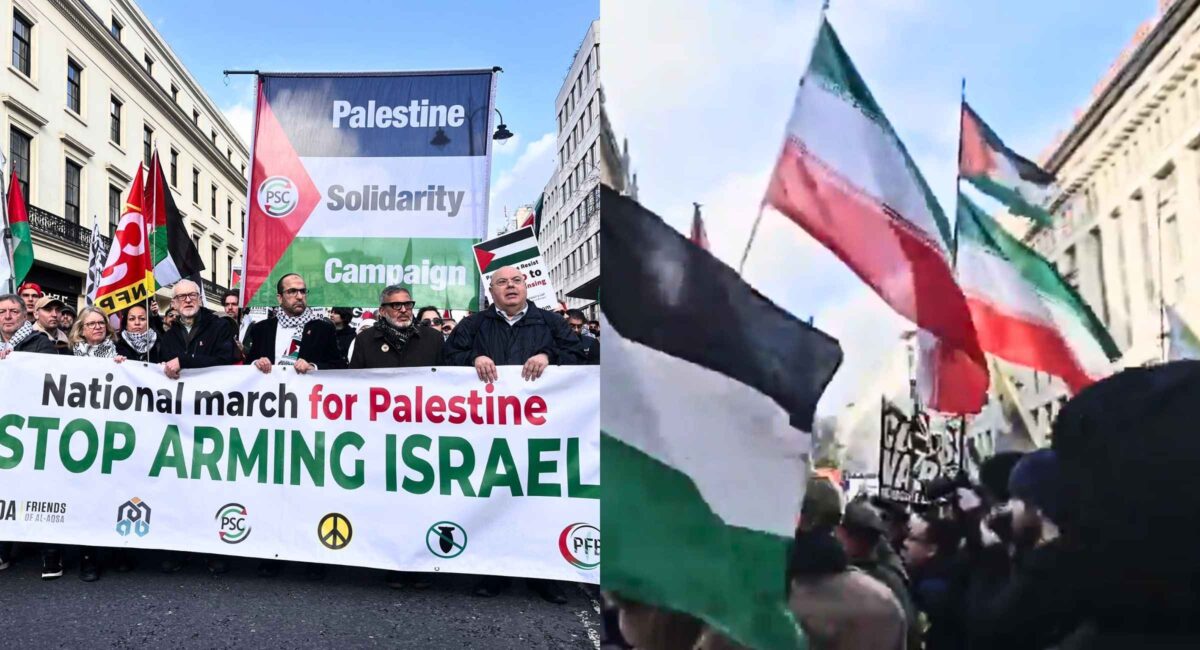
On 1 February 2026, the London National March — a major pro-Palestine demonstration organized by the Palestine Solidarity Campaign and allied groups — drew tens of thousands of participants through central London, calling for a ceasefire in Gaza and an end to British arms sales to Israel. However, the event also saw a **small but highly controversial subset of demonstrators wave Iranian flags and chant phrases praising Iran’s leadership — including “Khamenei makes us proud” — igniting sharp backlash from UK dissidents, media commentators, and political figures.
What Happened at the London National March?
Mass Demonstration With Broad Protest Aims
The “National March for Palestine” has been a recurring event in London since the Gaza war began in October 2023, regularly drawing tens of thousands of marchers demanding an immediate ceasefire, humanitarian aid corridors, and an end to UK arms exports to Israel. Past marches have shown massive crowds gathering at key sites such as Russell Square and Parliament Square before moving through Whitehall.
On this occasion, participants carried Palestinian flags, banners, and placards advocating for humanitarian relief and “Stop arming Israel.” Many marchers also called for broader global pressure on governments they see as complicit in the ongoing conflict.
Controversial Chants and Symbolism
While the majority of the march focused on anti-war messaging, a notable minority introduced chants and symbols connected to the Iranian regime.
- Police confirmed that around a dozen arrests were made during the demonstration, including some linked to disorderly behavior.
- Broadcast footage and participant reports show certain groups within the march waving Iranian flags and chanting slogans that explicitly praised Iran’s Supreme Leader, including variations of “Khamenei makes us proud.” These chants were seized upon by critics as evidence that the protest had been infiltrated by actors with pro-Iranian political motivations rather than solely pro-Palestine solidarity.
This development markedly complicated the narrative of the march. Organizers and mainstream participants maintained that the core purpose remained a call for peace and humanitarian support, but the inflammatory slogans drew media attention and political condemnation.
Why This Sparked Outrage
Political Backlash in the UK
In media commentary — particularly on platforms like GB News — critics characterized the presence of pro-Iran chants and flags as extremist and deeply inappropriate for a British protest focused on human rights. One commentator described it as a “genocidal fanclub for the Ayatollahs” and a troubling departure from lawful, peaceful protest.
This reaction was amplified by a wider context of mounting scrutiny over protest rhetoric in the UK. Analysts and commentators on both sides of the debate have noted that right-wing media outlets have disproportionately highlighted frightening or incendiary moments at pro-Palestine protests — with one media analysis finding major UK conservative newspapers rarely publish positive or nuanced coverage of these demonstrations.
Broader Context: UK Arms Sales and Gaza Airstrikes
What Protesters Are Aiming At
The London National March did not occur in a vacuum. Marchers reiterated longstanding grievances over:
- Continued UK arms exports to Israel, which protesters say implicate the British government in alleged violations of international law during the Gaza conflict.
- Perceived inaction by Prime Minister Rishi Sunak’s government despite large public demonstrations.
These grievances reflect weeks and months of sustained pressure, including parliamentary questions and civil society campaigns calling for the UK to restrict or halt military cooperation with Israel until a verifiable ceasefire is achieved.
Who Attended — and Who Didn’t
The march drew a wide range of participants:
- Labour MPs and British-Palestinian activists, who stressed humanitarian objectives over geopolitical alignment.
- Young people and families, according to on-site coverage and social media reporting.
Notably, mainstream organizers and the majority of attendees did not endorse chants praising foreign leaders. Nevertheless, the presence of a vocal fringe group has overshadowed much of the conventional messaging in news coverage.
Security and Policing
London’s Metropolitan Police deployed officers throughout the march to maintain order. Arrests were made both for public order offenses and in response to aggressive behavior.
Officials have stressed they are committed to facilitating peaceful protest while enforcing the law against hate speech and criminal conduct. This dual role has often placed police under intense public scrutiny during high-profile demonstrations.
Public Reaction: Divided Responses
Public reaction has been sharply divided:
- Supporters of the march argue that the right to protest foreign policy decisions is a cornerstone of democratic expression and that the focus on a few controversial chants distracts from pressing humanitarian concerns.
- Critics say chants praising authoritarian leaders (in this case, Supreme Leader Ayatollah Khamenei) cross a line into political extremism and undermine legitimacy.
The tension between these views is a defining feature of UK public discourse on the Israel-Gaza conflict.
What Organisers Say vs. What Critics Claim
Organizers, including the Palestine Solidarity Campaign, have reiterated that their goal is a humanitarian ceasefire and accountability for civilian casualties, not endorsement of foreign state actors or extremist ideology. They have publicly denounced violence and rhetoric that does not align with their stated aims.
Critics counter that anytime external political symbols — such as Iranian flags or slogans about its leadership — appear in such a context, it risks legitimizing agendas unrelated to the core cause of ending civilian suffering in Gaza.
Why This Matters
This protest exemplifies broader tensions in Western societies:
- Freedom of expression vs. concern about extremist sympathies
- Humanitarian protest vs. geopolitical symbolism
- Legitimate criticism of foreign policy vs. allegations of hate speech
These dynamics are not unique to London but are mirrored across major cities worldwide where similar rallies have taken place.
Conclusion: A Focal Point of Global and Local Politics
The London National March for Palestine remains a significant public expression of opposition to the Gaza airstrikes and UK government policies on arms sales. Yet the emergence of Iran-linked chants and symbols at the same event has sparked controversy far beyond the march itself, drawing attention from political commentators and broad swathes of the British public.
From my years covering mass demonstrations and geopolitical protests, this moment reflects a recurring pattern: large movements with clear humanitarian demands can be overshadowed when fringe elements align with external ideological messages — especially those connected to contentious state actors. The ongoing debate in the UK underscores how protests that begin with one set of motivations can rapidly become battlegrounds for broader political narratives, both domestically and internationally.