USS Abraham Lincoln Carrier Group Deployment and Trump’s Iran Threat
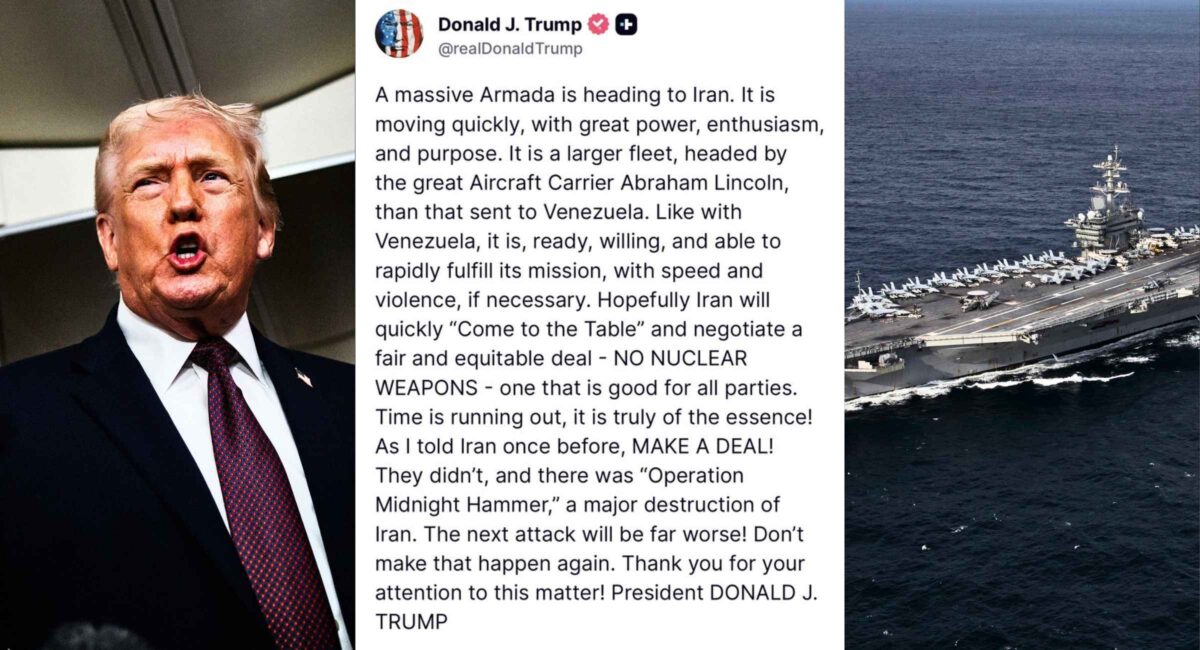
The USS Abraham Lincoln Carrier Strike Group, a powerful U.S. Navy task force centered on the Nimitz-class aircraft carrier USS Abraham Lincoln (CVN-72), has arrived in the U.S. Central Command (CENTCOM) area of responsibility in the Middle East, signaling a major escalation in tensions with Iran. President Donald Trump warned that if Tehran does not reach a deal to curb its nuclear ambitions, the United States may launch a military strike “far worse” than last year’s Operation Midnight Hammer, which targeted Iranian nuclear facilities. His warning — posted on Truth Social — accompanies the deployment of this armada and continues a dramatic intensification of U.S. pressure on Iran.
Key Takeaways
- The USS Abraham Lincoln Carrier Strike Group has entered the CENTCOM region amid U.S.–Iran tensions.
- President Trump warned of an attack “far worse” than Operation Midnight Hammer if Iran rejects negotiations.
- Tehran says any strike would be met with strong retaliation.
- The deployment reflects both deterrence and pressure for a nuclear deal.
Why This Matters
This development isn’t a routine naval exercise. The USS Abraham Lincoln Carrier Group represents some of the U.S. Navy’s most formidable assets — from fighter jets and destroyers to integrated surveillance and strike capability — moving into striking distance of Iran. It is a strategic demonstration of U.S. military resolve, but one that comes with real geopolitical and regional security risks at a time when U.S.–Iran relations are already at a flashpoint.
What Trump Is Saying: Far Worse Than Operation Midnight Hammer
In a Truth Social post that has reverberated across global capitals, President Trump wrote that the “massive armada” led by the USS Abraham Lincoln is:
- Bigger than the fleet sent to Venezuela earlier this year, a reference to a high-profile deployment tied to that country’s political crisis.
- “Ready, willing, and able to rapidly fulfill its mission, with speed and violence, if necessary.”
- Urging Iran to “come to the table” and negotiate a **nuclear deal — NO NUCLEAR WEAPONS — one that is good for all parties.”
- Reiterating that past inaction by Iran after U.S. demands led to Operation Midnight Hammer in June 2025, and warning that “the next attack will be far worse.”
Operation Midnight Hammer was the code name for U.S. strikes on Iranian nuclear sites in June 2025, involving bunker-busting bombs and cruise missiles aimed at nuclear infrastructure, causing significant damage and temporarily setting back Iran’s enrichment capabilities.
Trump’s latest rhetoric pledges even more severe action if Iran continues to reject negotiations, marking one of the most aggressive U.S. public statements toward Tehran in years.
USS Abraham Lincoln Carrier Strike Group: What It Includes
The USS Abraham Lincoln Carrier Strike Group (CSG) — now reported by U.S. Central Command to have crossed into the Middle East region — typically comprises:
- USS Abraham Lincoln (CVN-72) — a Nimitz-class nuclear-powered aircraft carrier.
- Multiple guided-missile destroyers and escort ships providing air defense and surface attack capability.
- Carrier Air Wing aircraft including F/A-18 fighters, early-warning aircraft, and support assets.
- Integrated logistics and reconnaissance elements.
The CSG is designed to project sustained air, sea and electronic power anywhere within its operational range, and its deployment in the Middle East underscores the seriousness with which U.S. leadership views the current standoff with Iran.
Regional Security Context: Multi-Front Tension
1. Escalating Rhetoric and Threats
Trump’s repeated warnings — including that the next strike will exceed the destructive scale of Operation Midnight Hammer — have heightened fears of a possible military campaign. While Trump frames these threats as leverage to force Iran back to negotiations, critics warn such statements can easily backfire and lead to miscalculation.
2. Iran’s Reaction
Iran’s leadership has responded sharply, saying any attack will be met with severe retaliation. Iranian military officials, including senior commanders and Revolutionary Guard leaders, have warned that any U.S. strike would escalate into a broader conflict and could target U.S. assets and allies throughout the region. Tehran has also stated its willingness to engage in dialogue but insisted it will defend its sovereignty if attacked.
3. Broader Middle East Dynamics
Across the region, allies and adversaries alike are watching closely:
- Qatar and other Gulf states have expressed concerns that military action could destabilize the entire Middle East and spark wider conflict.
- Proxy groups aligned with Iran, including Hezbollah and militia factions, have threatened to escalate or join any confrontation.
- Regional airspace restrictions and diplomatic pressures complicate potential military actions.
Diplomacy vs. Military Action: A Delicate Balance
Trump’s messaging has mixed diplomacy with threats. On one hand, he insists Iran can avoid conflict by agreeing to a comprehensive deal; on the other, his emphasis on readiness for “speed and violence” signals that military options remain firmly on the table.
Analysts point out that the presence of the USS Abraham Lincoln Carrier Group — traditionally a deterrence and response force — adds complexity to diplomatic channels. While the U.S. affirms that dialogue remains open, the scale of the naval deployment may be interpreted by Tehran as preparation for conflict.
Historical Backdrop: U.S.–Iran Military Confrontations
Tensions between Washington and Tehran have waxed and waned for decades, but recent years have seen some of the most serious clashes since the 1980s. The 2025 Operation Midnight Hammer strikes were the first direct U.S. attack on Iranian nuclear targets since the 1988 naval offensive at the end of the Iran–Iraq War, underscoring the gravity of the current crisis.
Military and Strategic Implications
Risk of Full-Scale Conflict
If Trump’s warning leads to military action, the conflict could rapidly escalate beyond limited strikes on nuclear sites or leadership targets. Given Iran’s military capabilities — including ballistic missile forces, air defenses and alliances with regional militias — any U.S. operation risks a broader regional confrontation.
Global Security and Economic Fallout
The Strait of Hormuz, through which a significant portion of the world’s oil passes, lies near any potential theatre of conflict. Disruption there could send global energy prices sharply higher and trigger economic shocks. Regional instability could also draw in global powers with strategic interests in the Middle East.
Conclusion: A Pivotal Moment in U.S.–Iran Relations
The arrival of the USS Abraham Lincoln Carrier Group in the Middle East and President Trump’s intensified warnings represent a critical juncture in U.S.–Iran relations. With rhetoric framing a possible strike “far worse” than past actions and a powerful naval force now in place, the situation teeters between diplomatic pressure and potential military confrontation.
For global leaders, policymakers, and citizens alike, the immediate future rests on how both Washington and Tehran interpret and respond to these signals. If Iran agrees to serious negotiations, conflict may yet be averted. But as Trump’s language makes clear, the option for force remains very much alive — and so do the risks that come with it.